
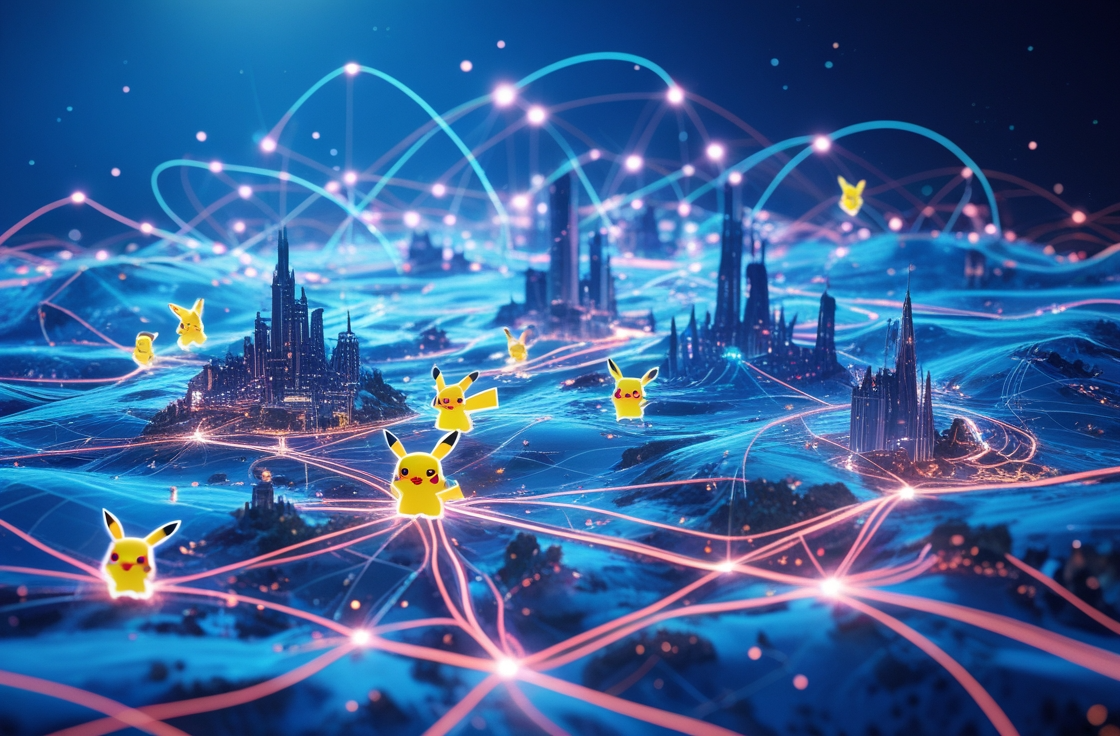
Niantic, the developer of the popular game Pokémon Go, has announced the development of an advanced artificial intelligence model that can reflect the physical world.
This was reported in the company’s official blog.
The new geospatial model will use data gathered from players to create visual scenes, integrating them with a global network of similar maps.
This innovative technology by Niantic is based on geolocation data from the real world, which players provide while scanning locations in Pokémon Go and other company games. It is important to note that participation in this process is voluntary.
“To train the AI, the user must visit a public place and scan it. Simply playing our products does not contribute to training the model,” the company explains.
Over the last five years, Niantic has developed a visual positioning system (VPS) that allows the precise determination of the phone’s coordinates and orientation with a single snapshot. The foundation of this technology is 3D maps created by players scanning landmarks. Today, the system covers 10 million scanned objects worldwide, and around 1 million new records are added each week.

Illustrative diagram of the geospatial model training
(image or diagram, if available)
Pokémon Go, released in 2016, was a pioneer in the field of augmented reality games. In this game, players catch virtual Pokémon in the real world using their mobile devices. Since its release, the game has been downloaded over 600 million times. In addition to catching Pokémon, players can collect resources at PokéStops and participate in gym battles located near real-world landmarks.